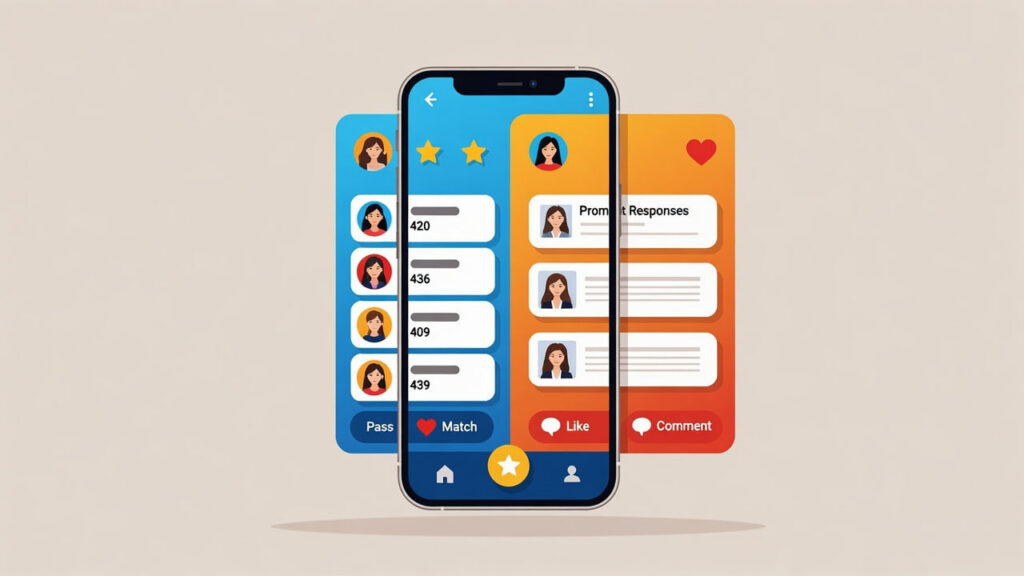
Bumble vs Hinge: Which Dating App Works Better for Men in 2026?
📖 Table of Contents
- Quick Verdict
- Side‑by‑Side Comparison
- 1. Gender Ratio (the most critical factor)
- 2. Who Messages First – the Key Difference
- 3. Profile Format: Looks vs Personality
- 4. Match Quality and Seriousness of Intent
- 5. Daily Limits and Pricing
- Final Verdict: Who Should Choose Which
- Choose HINGE if:
- Choose BUMBLE if:
- Conclusion
Online dating in 2026 is a high‑stakes game, especially for men. Studies consistently show that men outnumber women on most platforms, competition for matches is fierce, and the pressure to craft a standout profile and send the first message falls largely on men’s shoulders.
Bumble and Hinge are the two leading contenders for the title of best app for serious relationships. Both position themselves as alternatives to Tinder, but they approach it in fundamentally different ways. Hinge bets on depth of profiles and meaningful conversations; Bumble bets on women controlling the first move.
Which app should you give your time to in 2026? Let’s break it down point by point.
Quick Verdict
Hinge is the better choice for most men looking for serious relationships. You can message first, the gender ratio is favourable, and the profile format lets you show personality, not just looks.
Bumble is a great option for men who prefer quality over quantity and are willing to wait for women to make the first move. It suits those who value control over incoming messages and appreciate a higher signal‑to‑noise ratio.
Side‑by‑Side Comparison
1. Gender Ratio (the most critical factor)
For men, this is arguably the most important metric. The closer the ratio is to 50/50, the less competition you face.
| Metric | Hinge | Bumble |
|---|---|---|
| Male‑to‑female ratio | ~60% men, 40% women | ~59% women, 41% men |
| Men per woman | 1.5 | ~1.4 |
At first glance, Bumble looks slightly better – women even slightly outnumber men. However, the difference is minimal, and both apps significantly outperform Tinder, where there are about three men for every woman.
Winner: Tie (both are much better than the competition).
2. Who Messages First – the Key Difference
This is the main functional distinction that completely changes the user experience.
Hinge: Anyone can message first by leaving a comment on a photo or a prompt answer in the profile. This gives men agency – you don’t have to wait for someone to write to you. You can initiate, show wit, and personalise your approach.
57% of men report not receiving enough messages on dating apps. Hinge eliminates that frustration.
Bumble: In heterosexual matches, only women can send the first message. They have 24 hours after a match to send a message, or the match disappears. That means you cannot initiate – only wait.
Pros for men on Bumble: any woman who messages you has done so deliberately. This significantly raises the quality of interaction and reduces ghosting. Women report 48% fewer unwanted contacts on Bumble compared to other apps.
Winner: Hinge. The ability to take initiative is a huge advantage for men, especially given that men typically get replies on only 3–5% of their swipes.
3. Profile Format: Looks vs Personality
Hinge: Profiles are built around 6 photos/videos and 3 answers to prompts (up to 225 characters each). Questions like “My ideal Sunday is…” or “The key to my heart is…” give your potential matches concrete conversation starters. There is no traditional bio – only prompts.
Bumble: Profiles consist of 6 photos + a bio of up to 300 characters + 3 prompts (up to 120 characters). A more standard format, closer to Tinder.
What this means for men: Photo‑first apps (Bumble) heavily reward looks. Prompt‑first apps (Hinge) reward personality, wit, and the ability to say something interesting. Men who are not conventionally photogenic but have strong personalities perform significantly better on Hinge.
Winner: Hinge – especially for men who can showcase intelligence and humour in text.
4. Match Quality and Seriousness of Intent
Both apps attract relationship‑oriented users, but data shows Hinge is slightly more serious.
| Metric | Hinge | Bumble |
|---|---|---|
| Users looking for serious relationships | 87–90% | 80%+ |
| Primary age range | 25–34 | 22–35 |
| Core audience | Relationships | Friendships + dating + networking |
Hinge markets itself as the app “designed to be deleted” – its clear goal is to help users find real relationships, not to swipe endlessly. Bumble is a multi‑mode app (Date + BFF + Bizz), and not all users are in “serious dating” mode.
Conversations on Hinge typically go further than on Tinder. More matches turn into real dates. More dates turn into second dates.
Winner: Hinge (slight edge).
5. Daily Limits and Pricing
| Metric | Hinge | Bumble |
|---|---|---|
| Likes per day (free) | 8 | ~100 swipes |
| See who liked you | Yes, one by one (free) | Only with Premium |
| Change location | Free | Only with Premium |
| Filters | Free | Only with Premium |
| Premium price | $14.99–$50/month | $29.99–$79.99/month |
| Free experience | Best | Limited |
Hinge offers a much more generous free version. You can see who liked you, change location, and use filters without a subscription. Bumble hides these features behind a paywall, and Bumble Premium is more expensive.
Winner: Hinge.
Final Verdict: Who Should Choose Which
Choose HINGE if:
- You want to message first and not wait for women to initiate.
- You are looking for serious relationships, not casual flings.
- You are willing to invest time in a quality profile with thoughtful answers.
- You are not a supermodel but can be witty and interesting in text.
- You value free functionality (seeing likes, filters, location change).
- You are in the 25–40 age range in a major city.
“For men, Hinge wins by a large margin. You have agency. You’re not waiting, hoping matches will message you.”
Choose BUMBLE if:
- You are comfortable with a passive role – you are willing to wait for women to message first.
- You value quality over quantity – every message from a woman represents her deliberate interest.
- You are annoyed by low‑quality incoming messages – on Bumble there are fewer, but they are better.
- You want to use the app not only for dating but also for finding friends (BFF) or networking (Bizz).
- You live in a large city and can afford to wait.
- You are in the 22–35 age range.
Conclusion
In 2026, Hinge is the stronger choice for the majority of men. The ability to message first, better free features, a profile format that allows personality to shine, and a high proportion of users seeking serious relationships make it the most reliable app.
Bumble is a great alternative for those who value higher‑quality interactions and are willing to sacrifice control over the first message in exchange for more deliberate matches.
However, as experts note, there is no one‑size‑fits‑all solution in online dating. Men are often advised to use both apps simultaneously to maximise their chances. Ultimately, the right choice depends on your personal goals, age, location, and communication style.
Hinge for initiative. Bumble for quality. The best strategy – use both.

About LoveGuru
Love & dating expert helping you navigate modern relationships with confidence.
📚 Related Articles

Best Dating Apps for Serious Relationships (Not Just Hookups)
Find the app that helps you find the one. Not All Apps Are Built for…
Leave a Reply